Okta
Overview
Okta is a cloud-based identity and access management platform that provides secure authentication, authorization, and user management services. Okta helps organizations manage user identities across multiple applications and systems, providing single sign-on (SSO), multi-factor authentication (MFA), and comprehensive user lifecycle management.
- Vendor: Okta
- Product: Okta Identity Platform
- Supported environment: Cloud
Configure
How to create an API token with proper permissions
To connect Okta to Sekoia.io, you need to create an API token with the necessary permissions to access Okta users and groups. Follow these steps:
-
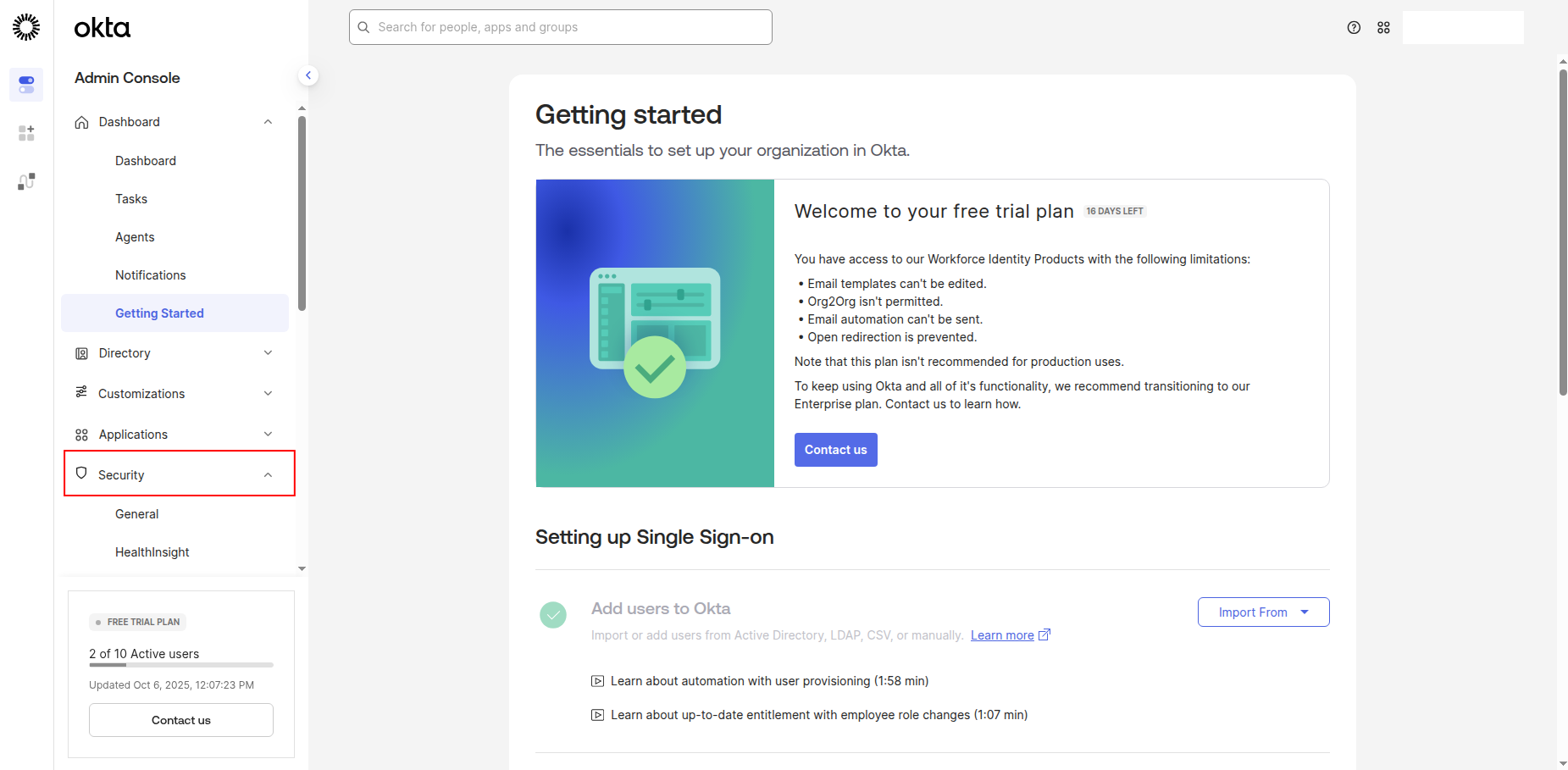
Sign in to your Okta Admin Console and navigate to the Security section.
-
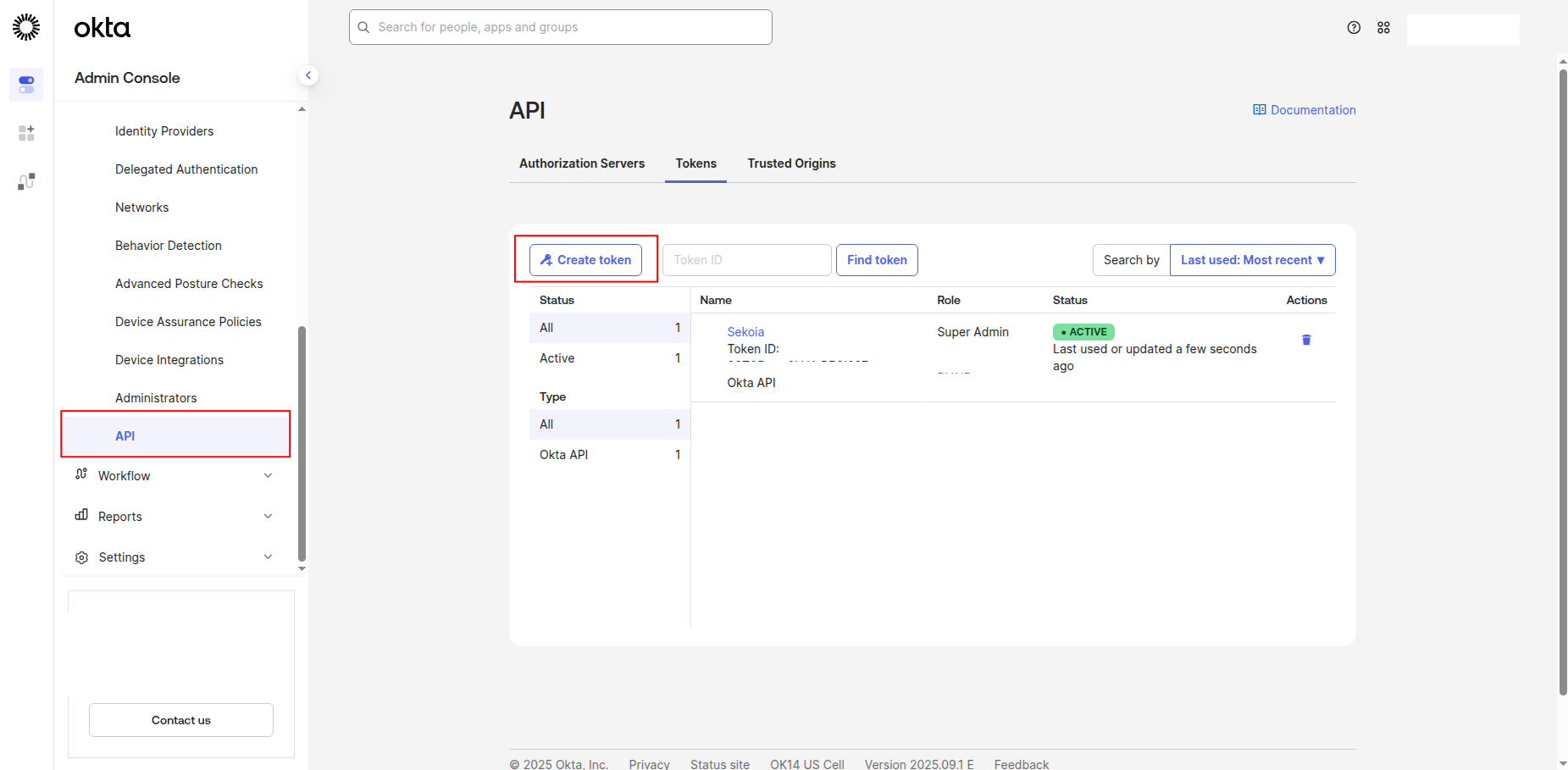
Click API in the left navigation pane, then click Tokens.
-
Click Create Token to generate a new API token.
-
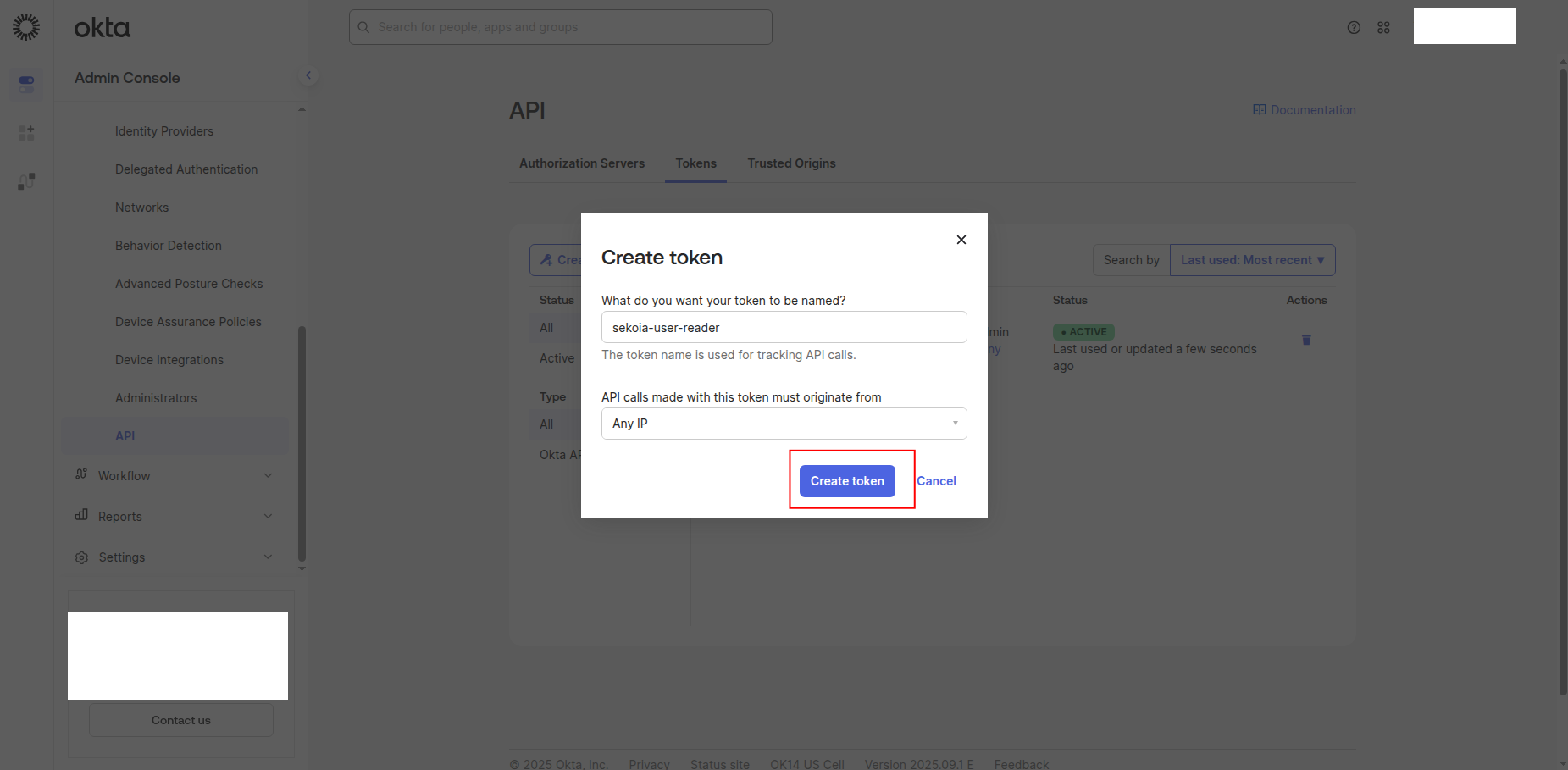
Enter a name for the token (e.g.,
sekoia-user-reader) -
Click Create Token to generate the API token.
-
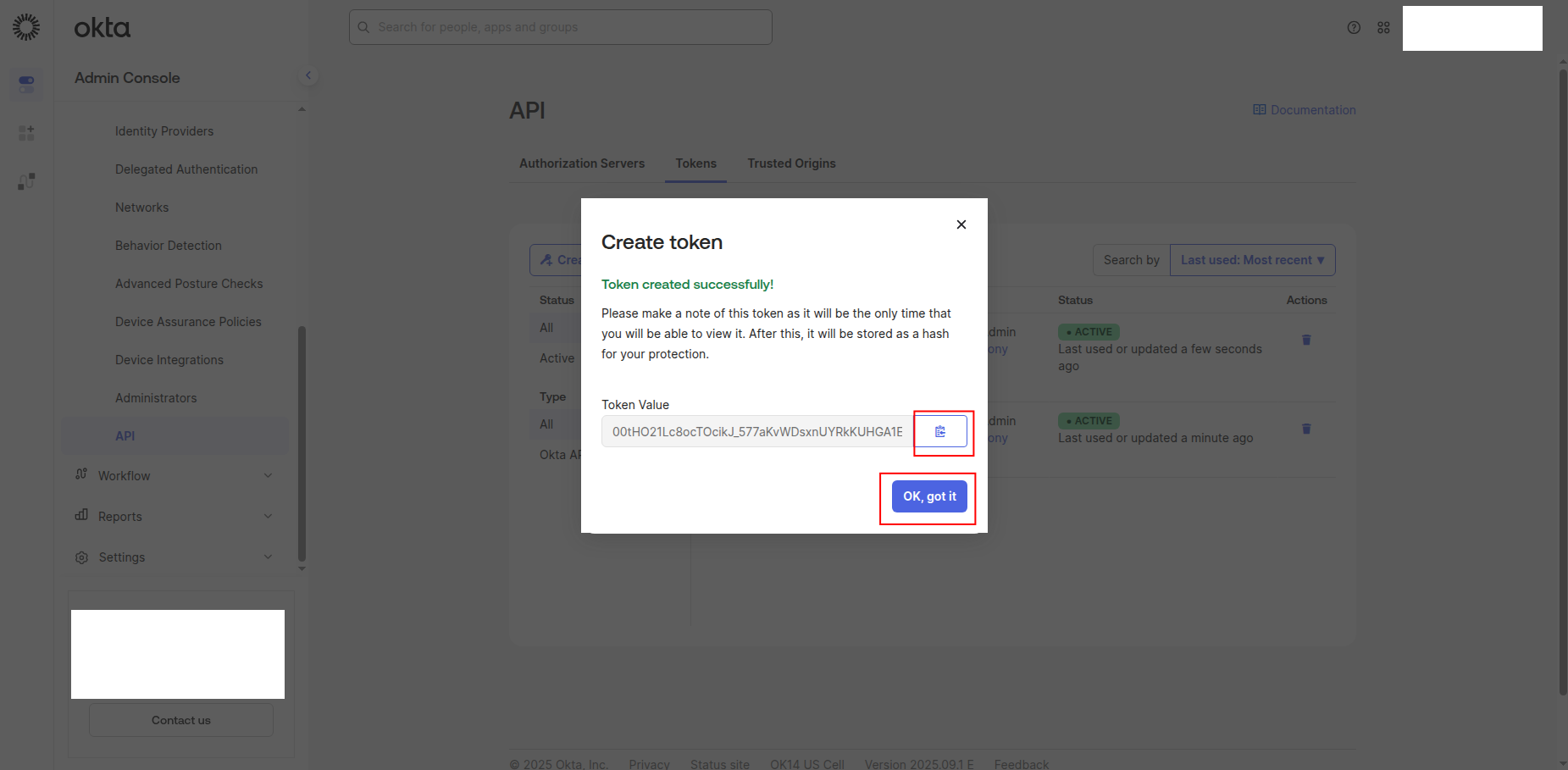
Copy the Token Value to a safe location. You'll need this token to configure the connector in Sekoia.io.
Warning
- The token value is only shown when you create it. If you lose it, you must create a new token.
- Store this token securely and never share it publicly.
- Consider rotating API tokens regularly for security best practices.
Required API permissions
The API token must have the following scopes to successfully fetch Okta users and groups:
{
    "scopes": [
        "okta.users.read",
        "okta.groups.read",
        "okta.users.manage"
    ]
}
Required Scopes:
okta.users.read: Read user profiles and attributesokta.groups.read: Read group information and membershipsokta.users.manage: Full user management capabilities
Create your asset
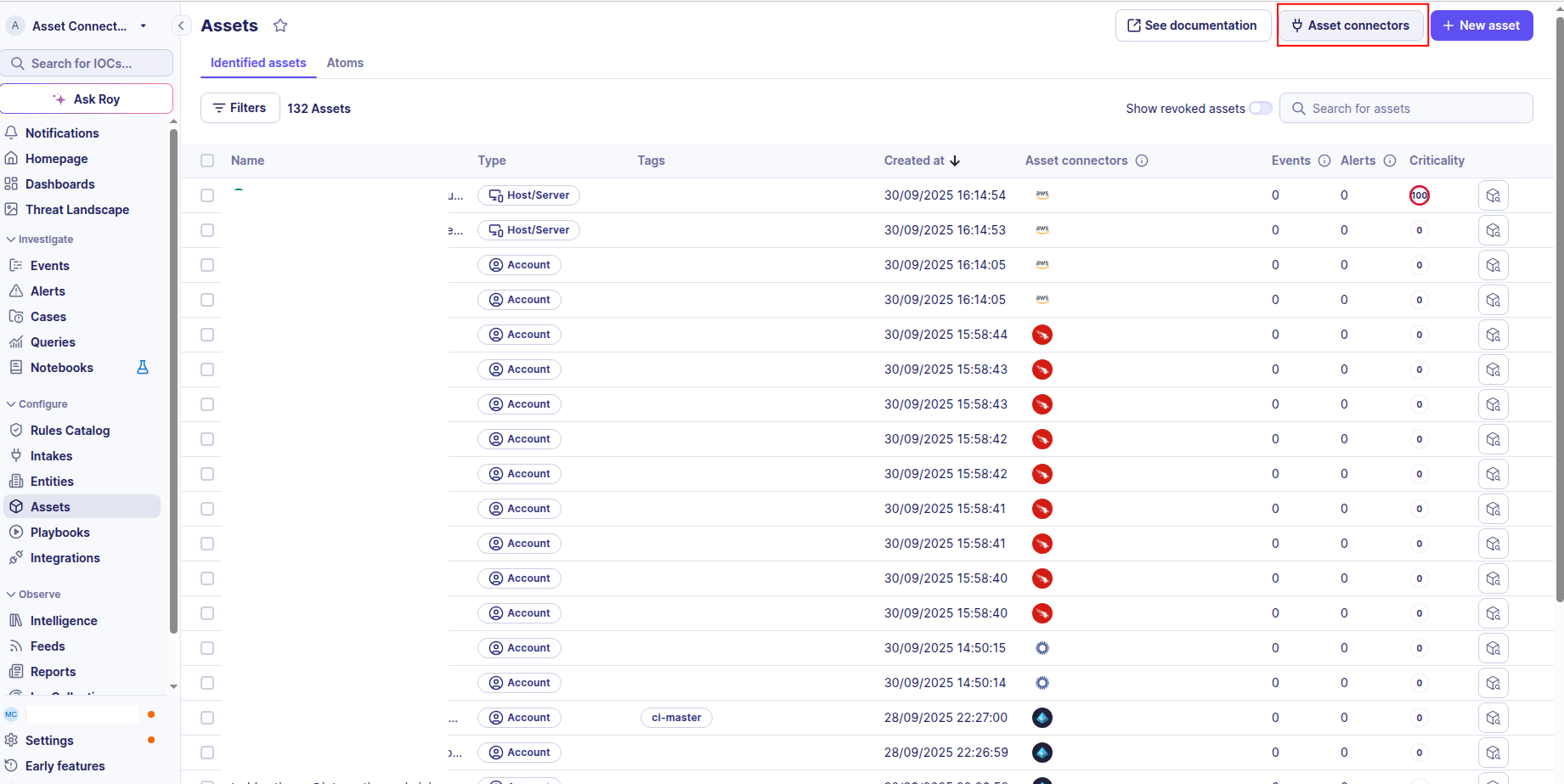
To start getting your Okta users into Sekoia.io, you need to create an asset connector on the Assets page. To do so, follow these steps:
-
Click the Asset connectors button to create a new connector.
-
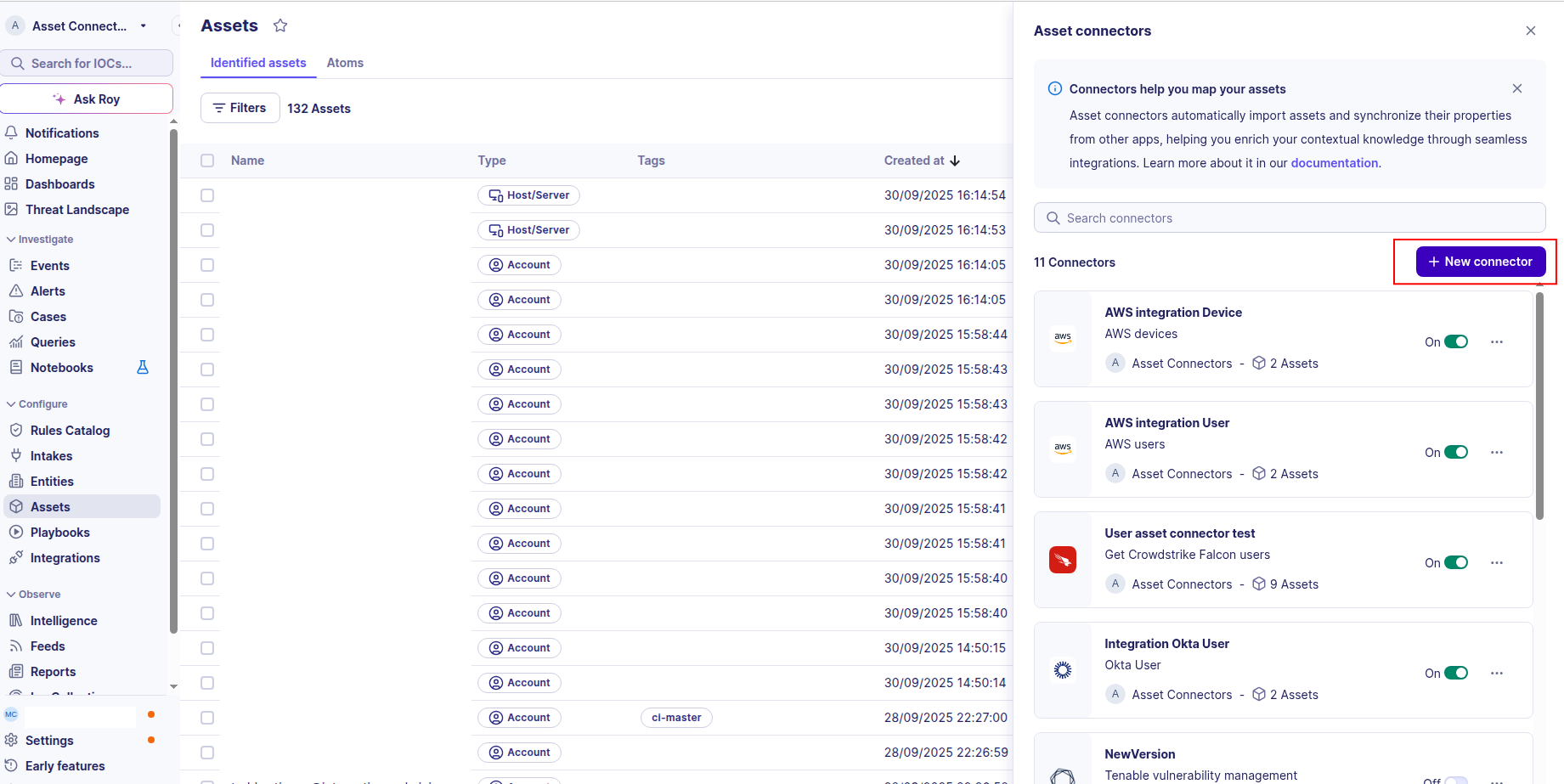
Click the + New connector button.
-
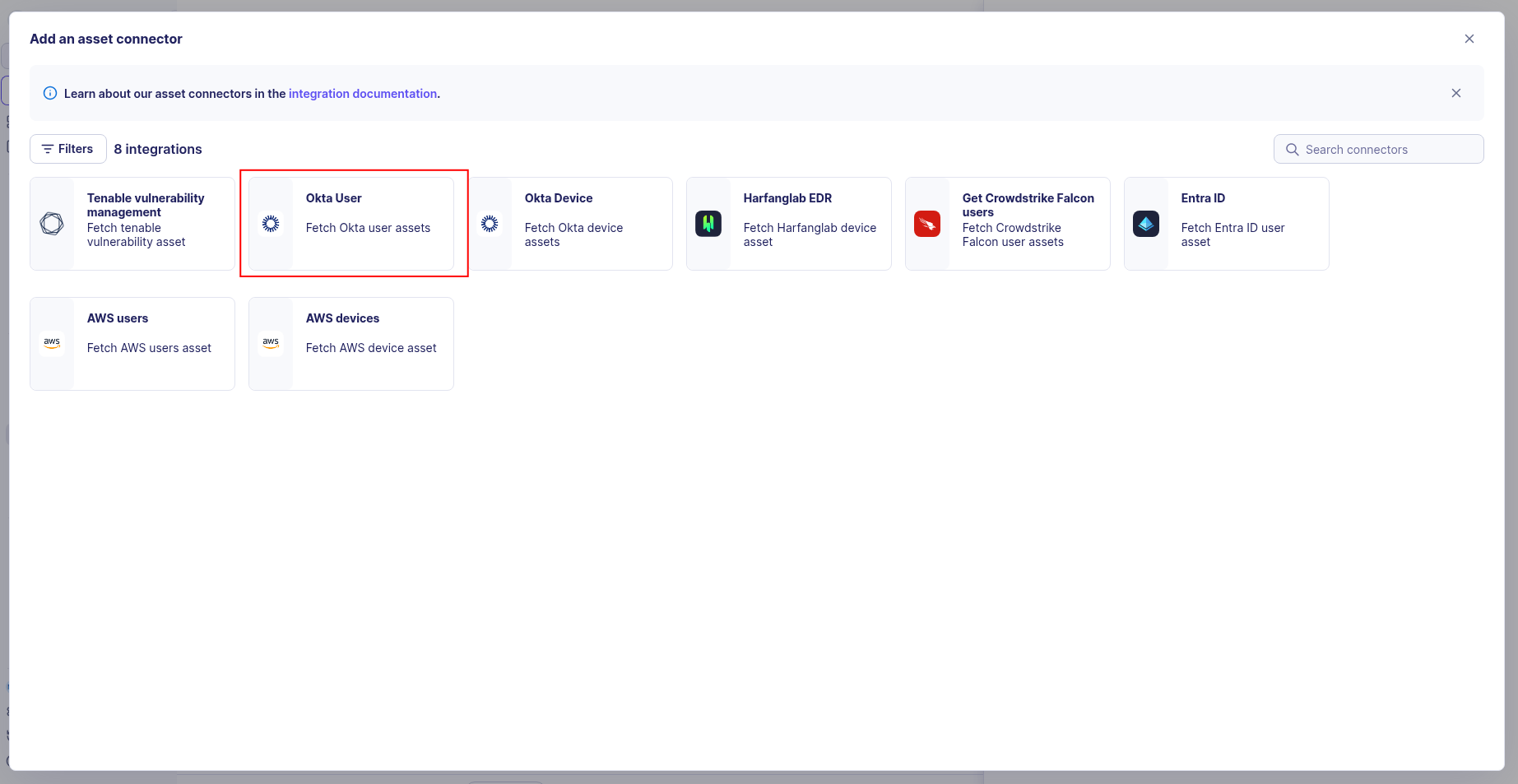
Choose Okta User, give it a name, and fill the required fields:
-
Enter the following information:
- API Token: The API token value from your Okta organization
-
Base URL: Your Okta organization's base URL (e.g.,
https://your-domain.okta.com) -
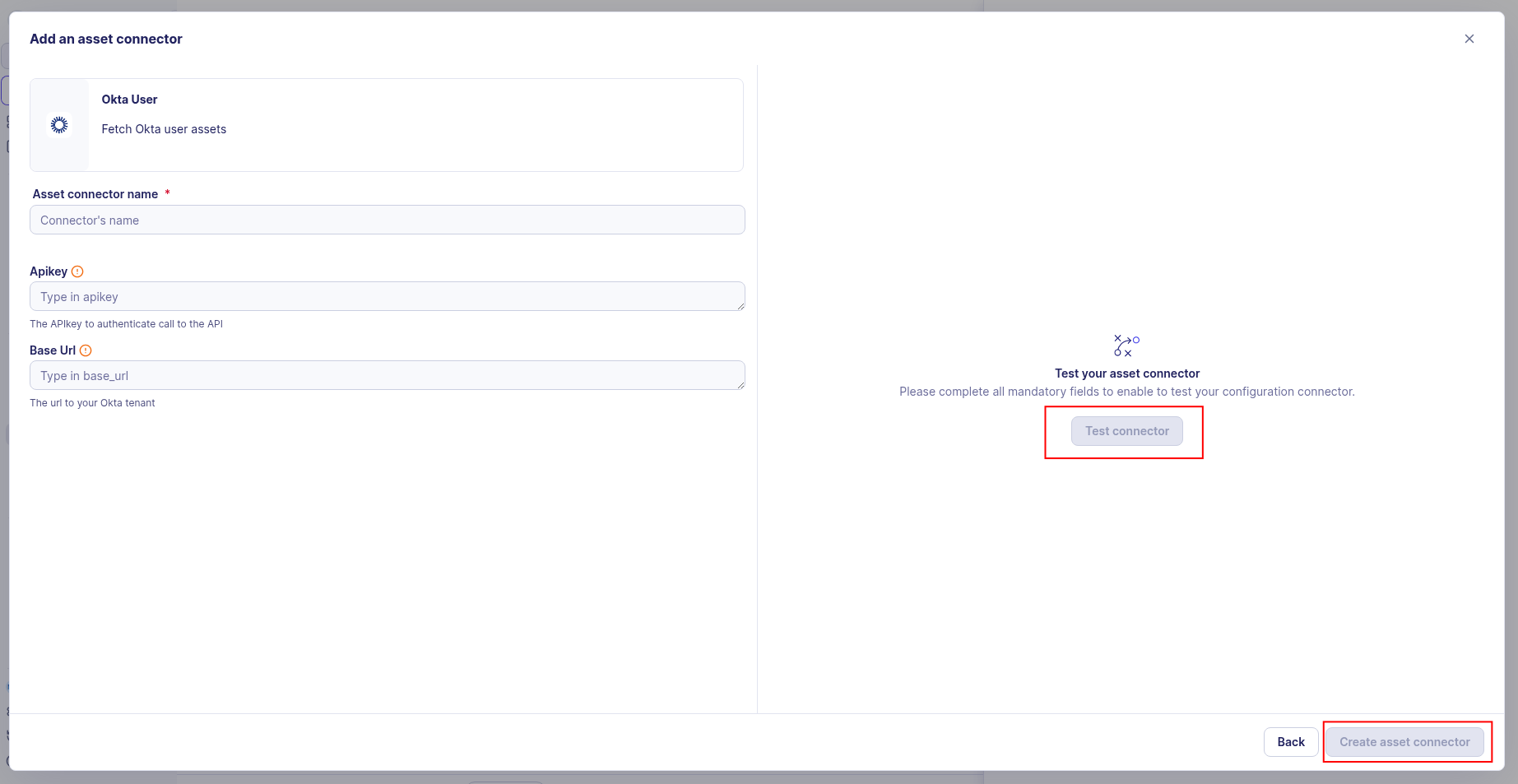
Test the connection by clicking the Test connector button.
-
Click the Create asset connector button.
OCSF Mapping for Okta Users
OCSF Class: User Inventory Info
Class UID: 5003
Information Collected
The Okta Users fetches comprehensive information and transforms it into the OCSF (Open Cybersecurity Schema Framework) format for standardized security monitoring and asset management.
API Response Examples
Okta Active User
Okta user with active status and group membership
{
  "id": "00oa1bcdefg2EXAMPLE",
  "status": "ACTIVE",
  "created": "2020-06-04T10:00:00.000Z",
  "activated": "2020-06-04T10:15:00.000Z",
  "statusChanged": "2025-08-26T09:30:00.000Z",
  "lastLogin": "2025-08-26T09:30:00.000Z",
  "lastUpdated": "2025-08-26T09:30:00.000Z",
  "passwordChanged": "2025-01-10T11:00:00.000Z",
  "profile": {
    "firstName": "Mary",
    "lastName": "Jones",
    "email": "mary.jones@example.com",
    "login": "mary.jones@example.com",
    "mobilePhone": "+1-555-234-5678",
    "primaryPhone": "+1-555-234-5678",
    "department": "Finance",
    "jobTitle": "Financial Analyst",
    "employeeNumber": "EMP456",
    "city": "New York",
    "state": "NY",
    "country": "USA"
  },
  "groupIds": [
    "00gj3k4l5mnopqrst",
    "00gh8i9j0klmnopq"
  ],
  "_links": {
    "self": [
      {
        "href": "https://example.okta.com/api/v1/users/00oa1bcdefg2EXAMPLE"
      }
    ]
  }
}
Okta Suspended User
Okta user with suspended status
{
  "id": "00oa2cdefgh3EXAMPLE",
  "status": "SUSPENDED",
  "created": "2020-06-04T10:00:00.000Z",
  "activated": "2020-06-04T10:15:00.000Z",
  "statusChanged": "2025-06-10T14:00:00.000Z",
  "lastLogin": "2025-06-10T14:00:00.000Z",
  "lastUpdated": "2025-06-10T14:00:00.000Z",
  "passwordChanged": "2021-01-15T09:00:00.000Z",
  "profile": {
    "firstName": "Robert",
    "lastName": "Smith",
    "email": "robert.smith@example.com",
    "login": "robert.smith@example.com",
    "mobilePhone": "+1-555-345-6789",
    "primaryPhone": "+1-555-345-6789",
    "department": "Engineering",
    "jobTitle": "Senior Software Engineer",
    "employeeNumber": "EMP789",
    "city": "San Francisco",
    "state": "CA",
    "country": "USA"
  },
  "groupIds": [
    "00gj3k4l5mnopqrst"
  ],
  "_links": {
    "self": [
      {
        "href": "https://example.okta.com/api/v1/users/00oa2cdefgh3EXAMPLE"
      }
    ]
  }
}
Data Mapping Table
The following table shows how source data is mapped to OCSF model fields:
| Source Field | OCSF Field Path | Description | Data Type | Logic |
|---|---|---|---|---|
static: 2 |
activity_id |
OCSF activity ID for inventory collection | integer |
Always 2 for 'Collect' activity |
static: Collect |
activity_name |
OCSF activity name | string |
Always 'Collect' |
static: Discovery |
category_name |
OCSF category name | string |
Always 'Discovery' |
static: 5 |
category_uid |
OCSF category UID | integer |
Always 5 for Discovery category |
static: User Inventory Info |
class_name |
OCSF class name | string |
Always 'User Inventory Info' |
static: 5003 |
class_uid |
OCSF class UID | integer |
Always 5003 for User Inventory Info |
static: 500302 |
type_uid |
OCSF type UID | integer |
Always 500302 for User Inventory Info: Collect type |
static: User Inventory Info: Collect |
type_name |
OCSF type name | string |
Always 'User Inventory Info: Collect' |
static: Informational |
severity |
Event severity level | string |
Always 'Informational' for inventory events |
static: 1 |
severity_id |
OCSF severity ID | integer |
Always 1 for Informational severity |
created |
time |
OCSF event timestamp (user discovery time) | integer |
Convert ISO 8601 to Unix epoch for OCSF event timestamp |
static: Okta |
metadata.product.name |
Source product name | string |
Always 'Okta' |
static: Okta |
metadata.product.vendor_name |
Source product vendor name | string |
Always 'Okta' |
static: N/A |
metadata.product.version |
Source product version | string |
Always 'N/A' since Okta is a SaaS product without traditional versioning |
static: 1.6.0 |
metadata.version |
OCSF schema version | string |
Fixed OCSF schema version |
id |
user.uid |
Okta user unique identifier | string |
Direct mapping of Okta user ID |
calculated: profile.firstName and profile.lastName |
user.full_name |
User full name | string |
Concatenate first and last names |
profile.email |
user.email_addr |
User email address | string |
Direct mapping of email address |
profile.login |
user.name |
User login/username (typically email) | string |
Direct mapping of user login |
profile.login |
user.account.name |
Account username (login) | string |
Direct mapping of user login |
static: OTHER |
user.account.type |
Account type identifier | string |
Always 'OTHER' for Okta account type |
static: 99 |
user.account.type_id |
OCSF account type ID | integer |
Always 99 for Okta account type |
id |
user.account.uid |
Idential Okta user ID for account correlation | string |
Direct mapping of Okta user ID as account UID for correlation |
group.id |
user.groups[].uid |
Group unique identifier | string |
Direct mapping of Okta group ID to group UID in user groups array |
group.profile.name |
user.groups[].name |
Group name | string |
Direct mapping of Okta group name to group name in user groups array |
group.profile.description |
user.groups[].desc |
Group description | string |
Direct mapping of Okta group description to group description in user groups array |
id |
user.has_mfa |
MFA enrollment status | boolean |
True if user has any MFA factors enrolled, false otherwise (requires additional API call to check factors) |
profile.displayName |
user.display_name |
User display name | string |
Direct mapping of display name |
calculated: profile.email |
user.domain |
User domain | string |
Extract domain from email address, otherwise set to null |
profile.login |
user.uid_alt |
Alternate user identifier (login/email) for correlation | string |
Direct mapping of user login as alternate UID for correlation |
calculated: roles assigned to user |
user.type_id |
User type ID | integer |
If user has admin roles, set to 'Admin'; otherwise set to 'None' |
calculated: roles assigned to user |
user.type |
User type | string |
If user has admin roles, set to 'Admin'; otherwise set to 'None' |
profile.organization |
user.org.name |
Organization name | string |
Use Okta profile.organization if present and string, else fall back to email domain |
profile.department |
user.org.ou_name |
Organizational unit name | string |
Use Okta profile.department if present and string, else set to null |
static: access_control |
enrichments[].name |
Enrichment name for access control insights | string |
Always 'access_control' for this enrichment |
static: okta |
enrichments[].value |
Enrichment value indicating Okta as source | string |
Always 'okta' to indicate enrichment source |
calculated: is user account enabled in Okta |
enrichments[].data.is_enabled |
Indicates if the user account is currently enabled in Okta | boolean |
True if user status is 'ACTIVE', false otherwise |
lastLogin |
enrichments[].data.last_logon |
The last time the user logged in according to Okta | string |
Map Okta lastLogin timestamp to enrichment data for last logon time |
passwordChanged |
enrichments[].data.last_time_password_change |
The last time the user changed their password according to Okta | integer |
Convert Okta passwordChanged timestamp to Unix epoch for enrichment data |
OCSF Model Structure
User Inventory Info: Collect
Transformed Okta user to OCSF User Inventory Info event
{
  "activity_id": 2,
  "activity_name": "Collect",
  "category_name": "Discovery",
  "category_uid": 5,
  "class_name": "User Inventory Info",
  "class_uid": 5003,
  "type_name": "User Inventory Info: Collect",
  "type_uid": 500302,
  "severity": "Informational",
  "severity_id": 1,
  "time": 1591234567.0,
  "metadata": {
    "product": {
      "name": "Okta",
      "vendor_name": "Okta",
      "version": "N/A"
    },
    "version": "1.6.0"
  },
  "user": {
    "uid": "00oa1bcdefg2EXAMPLE",
    "name": "mary.jones@example.com",
    "full_name": "Mary Jones",
    "display_name": "Mary Jones",
    "email_addr": "mary.jones@example.com",
    "uid_alt": "mary.jones@example.com",
    "domain": "example.com",
    "has_mfa": true,
    "type_id": null,
    "type": null,
    "account": {
      "uid": "00oa1bcdefg2EXAMPLE",
      "name": "mary.jones@example.com",
      "type": "Other",
      "type_id": 99
    },
    "org": {
      "name": "example.com",
      "ou_name": "Finance"
    },
    "groups": [
      {
        "uid": "00gj3k4l5mnopqrst",
        "name": "Finance Users",
        "desc": "Finance department group",
        "privileges": []
      }
    ]
  },
  "enrichments": [
    {
      "name": "access_control",
      "value": "okta",
      "data": {
        "is_enabled": true,
        "last_logon": "2025-08-26T09:30:00.000Z",
        "last_time_password_change": 1736507400.0
      }
    }
  ]
}